MiniatureBuildings.co.uk : Exploring model buildings of all sizes and styles
- Scale/Effect(top)
- Home
-
About
Us -
Recent
Articles -
Scales &
Uses - Modelling
-
All
Articles
Miniature Buildings
(top of page)
Home
Articles
- Miniature
Buildings - Home +
-
Recent
Blogs -
All
Articles
.
Miniature Buildings
Some thoughts on building models of all types and sizes
Some thoughts on building models of all types and sizes
Welcome. If you have not visited Minature Buildings before can I suggest you begin with my Aims and Scope article or at the Home Page. If you have visited before - welcome back. I hope this article is of interest to you.
Scale or Effect ?
Most Miniatures are, at least nominally, built to a particular scale. There are exceptions but for most modellers a key objective is to recreate their chosen prototype object in a particular and constant scale.
Posing the question "scale or effect" sounds neutral enough but I find it hard to develop or explore the question in a neutral way. For me, the question "how much should strict adherence to true scale be sacrificed in the interests of creating a pleasing effect" is a meaningful question. But the converse, "should we compromise on effect in the interests of scale", is harder to contemplate.
Building to scale represents, for me, a clearly identifiable starting point from which divergence can be observed - regardless of whether that variation is considered to be desirable or not. Yet I am conscious that I am displaying my own prejudices simply by posing the question in this way. Is this the difference between a mechanic and an artist; between left brain and right brain people?
There are clearly those for whom adherence to scale is a secondary
consideration. This view is pithily expressed in the interesting and
useful site www.newrailwaymodellers.co.uk
. In their FAQ pages they answer the question "How important is
scale?" with the view "Not at all. If you like the look of something
that is over or under scaled, who am I to tell you it's wrong. Do be aware
that some people are very snobby when it comes to scale". Which
puts me firmly in my place.
I don't entirely agree with them though. Either a door is the right height or it is not, either the tiles look realistic or they don't. But, there is always a but. A slate in real life might be, say, 10mm thick. 1/160 of that is less than 1/10th of a mm. Which means you have to choose. Do not bother to model the thickness, just use a printed or painted image. Or use overlapping strips, which are surely going to be thicker than scale thickness. You are going for effect rather than scale. Forget the rivets, or make them oversized? Doing it exactly to scale is surely beyond most (all?)of us?
My own version of rivet counting is about brick patterns. To the point of obsession sometimes. It manifests itself in two main places. Brick or stone forms the corner of buildings in most cases. They look like the first (real)example rather the second (a model); there is no seam down the corner:

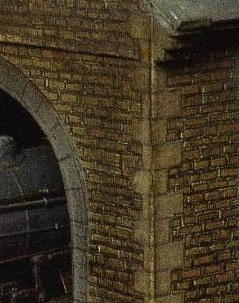
In 1/444 or below I cannot see the detail of the brick pattern (even with my reading glasses) but at larger scales - 1/76 or 1/87 or above it is possible to see the shape and size of individual bricks. Whatever the scale I think it is fundamental that paper wrap should go around the corner so that the gap between the underlying backing sheets. And your view?
The other place it matters (IMHO) is in the openings for windows and doors. Brick courses are often adjusted to create a specific pattern around the opening and windows are sized as a multiple of half bricks.
One of the high profile suppliers of buildings for model railway enthusiasts supply 'wraps' of building papers to provide the surface detail - such as brickwork - for their laser cut buildings. A while back I posed the question to them "The way you apply the brick paper makes no allowance for what the bricks will look like at the edges of the windows. You might have just 10% of a brick visible, or 95% rather than seeing a half brick, a whole stretcher length or sometimes a 3/4 brick ( a closer?). And the bottom may not align with the courses. Is that simply because the scale is so small you cannot see the detail?"
Their response was "On our kits, the brick courses are always designed so that the bricks will be as correct as they can be. There’s always a tolerance of course as not everyone will fit the wraps perfectly. If you’re working with brick papers, then you kinda just have to go with it as you can’t move the mortar lines on printed paper. You just have to do the best you can." To my mind this is a bit of a fudge. If the morter lines are visible to the naked eye then I do like to see them lined up 'properly'. Which means that brick paper ideally has to be printed to fit the underlying structure rathe than just using generic sheets. But that's just me being picky and why many of my projects never get completed while they have a flourishing business.
In a post in March 2025, in the 'Miniature Buildings and terrain' Facebook group, Neil Carleton used the phrase 'scale creep', which was not a concept I had come across before. He had modelled a medieval tower for use in wargaming, staying true to scale, and ended up with a building much bigger than he anticipated, "a bit too imposing when set next to my other .... buildings". He describes the experience as "a cautionary tale for builders".
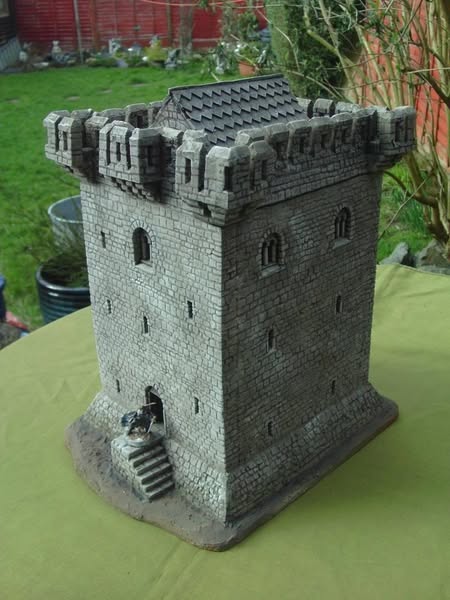
My own view is that the tower looks good, though I wonder if the roof slabs are a bit big and thick. Comments on the post were mixed. Many thought the model looked great. A buildings archaeologist remarked "your scale is good! Generally wargames buildings are far too small this isn’t out of scale at all."One commentator said "Vertical Scale is always an issue. Consider model trees... poplars and spruces can grow to 60 metres, so should be 30 times taller than an 6' man... which at 28mm would make them 84 centimetres high!". Another, rather strangely, said "technically, ... it's a little out of scale. But, I think it looks good". Which is surely the exact opposite to the fact that even though it's in scale it looks too big. A third commented "I find that scale creep when modelling is always upwards!" which I sort of agree with. But I suspect the real reason is that although we make the width of buildings to scale we never have room to make the spaces between buildings to scale.
This can be clearly seen in the world of model railways - even if the station is to scale it is unlikely that the platforms will be long enough for an 8 or 12 coach train. And the distance to the next station down the track....! One commentator described this better than I can by saying "Model railroaders have for years practiced "selective compression", where one keeps the distinctive features of a structure but reduces the size such as by using fewer floors and reducing the width and depth.".
A perfect illustration of this was provided by Grahame Hedges in a post in the always interesting Facebook group Model Rail Buildings - Mostly Card & Paper. He wrote: "I compress buildings to fit layout space by leaving out selected columns/bays of windows (rather than reducing the number of storeys) as well as slightly reducing overall size, but still hoping to capture the look and character of the real building. Here's my incomplete scratch-built model of Denmark and Emblem (formerly Colonial) Houses for my layout along with the real buildings for comparison."
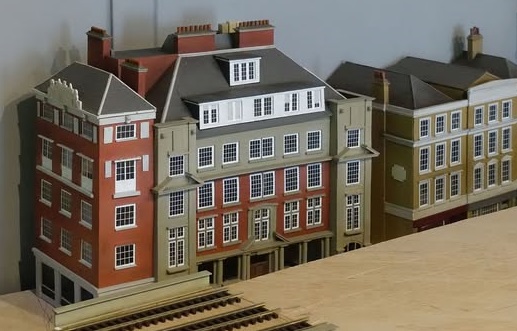
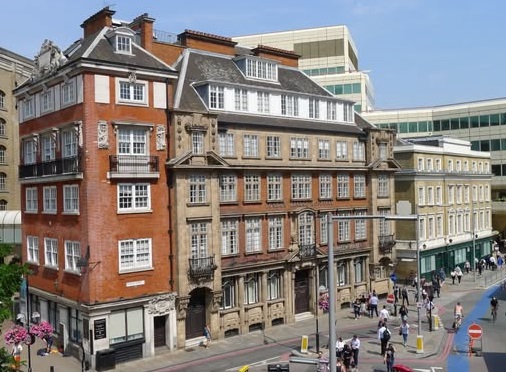
It is strange, but when I look at model railways it always seems as if model carriages are way too long, even though they are modelled to scale. The opposite approach is taken in wooden railways (Brio etc) for young children where both engines and carriages are made way shorter than the scale used for engine height and track width. As discussed in another article on my own model station.
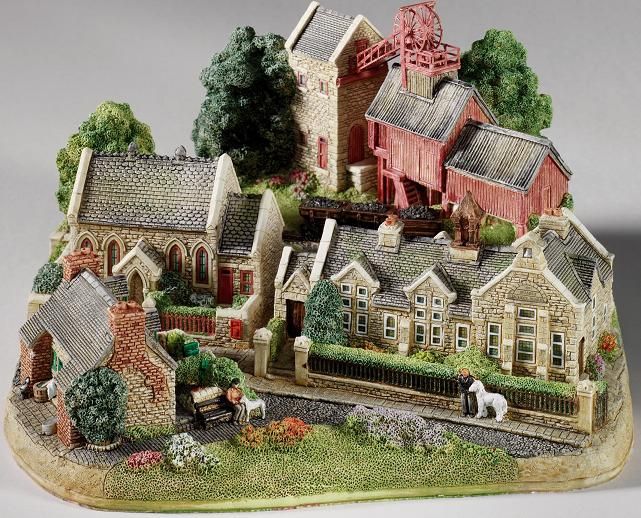
Leaving the fantasy modeller aside, for they are a rare species for whom effect must be everything, it appeared to me that the best people to approach for a view on the importance of effect would be the producers of resin models for the giftware market. Many years ago I did write to the makers of the well known Lilliput Lane range. My recollection of their reply was that they considered effect above all. That scale did not really feature in their modelling. They were, in their time, immensely popular but are no more. Though lots of collections still appear at auction houses - at prices which must seem ridiculously low to those collectors who bought them new at retail prices. They are still good examples of the breed.
But it is not really fair to ignore the fantasy modeller. This example is a 28mm scale cottage (with optional bakery add-on of a wood pile & outdoor oven) recently caught my eye. It is a design by Black Scroll Games. It is part of their City of Tarok range designed for Dungeons and Dragons, Pathfinder and Other DnD Like TableTop Games.
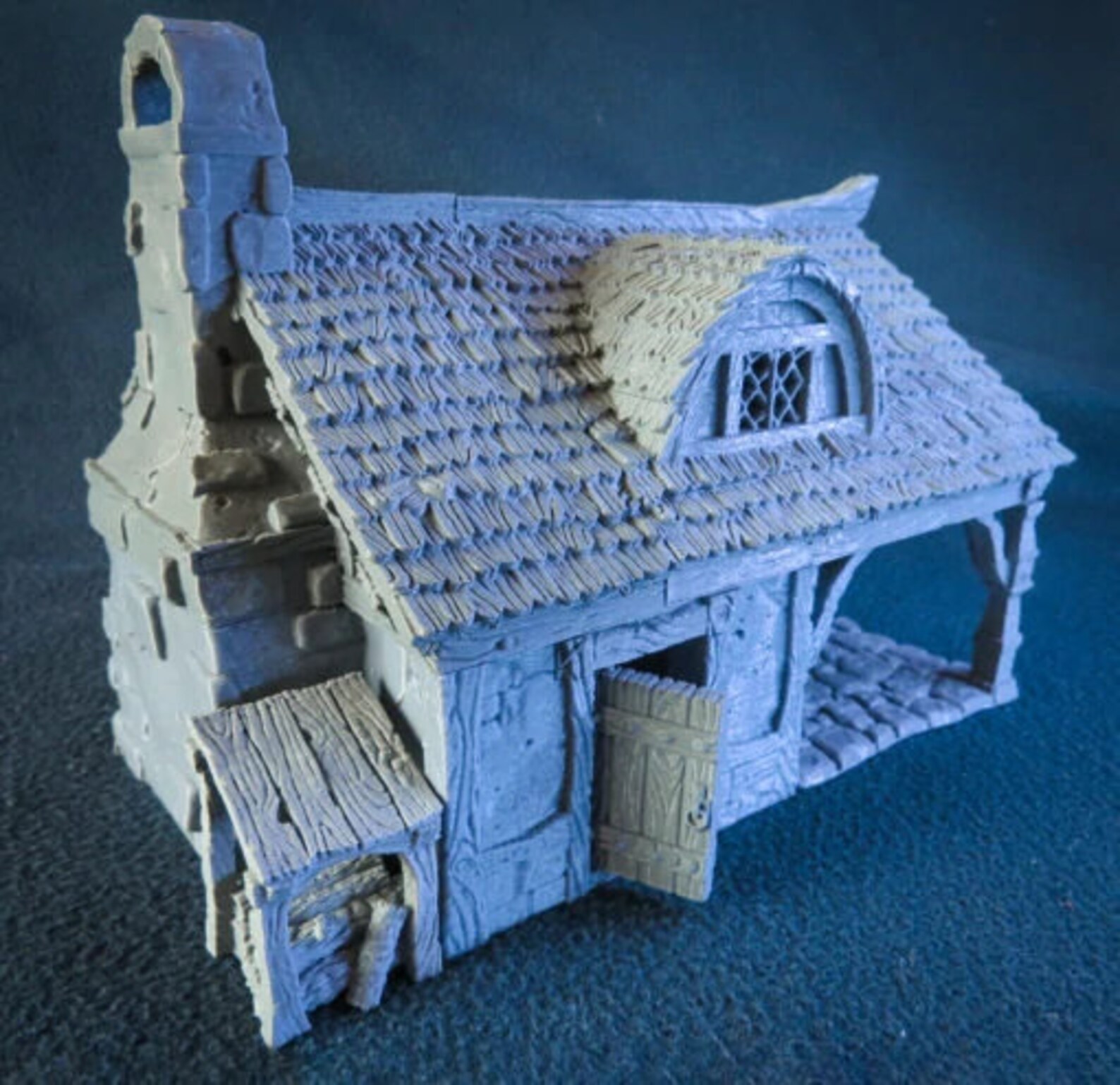
If that sounds disparaging it is not meant to be. I am not into D&D, and their like, and I suspect few of my readers are. But my concern is with the building models. I haven't seen any of this range in the flesh. Buying examples of everything I see on the web is beyond me, nor do I have house room for all the models I would like. But these models look nice and the comments from buyers are very favourable.
What I had not realised immediatly is that Black Scroll Games are not your regular model supplier. They provide downloadable files which the buyer can then use to 3D print the models. I had not realised (being an old guy) how many modelling enthusiasts there were out there with a 3D printer.
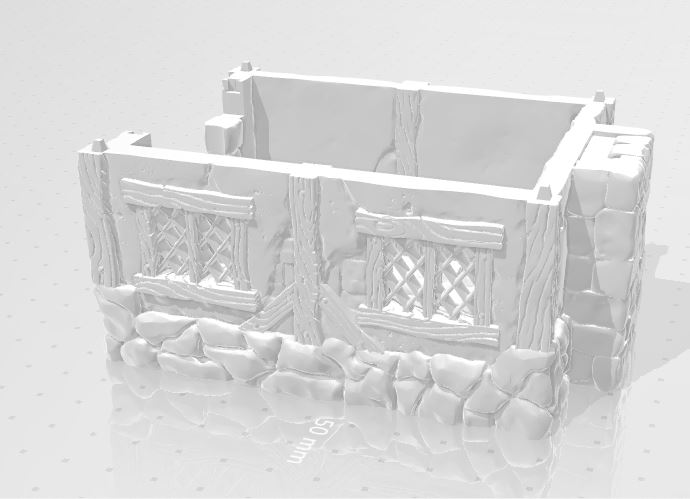

The Black Scroll site allows you to download the file for a simple cottage FOC. Or go to the top of the range $19.99 file of their roadside inn. If I had a 3D printer I would certainly be tempted.
But I am straying away from the scale or effect question. There is no doubt that in the fantasy gaming world effect is (almost) all. Since there are no prototypes there can be no scale models - just fantastic creations anchored, to a greater or lesser extent, in one or more periods of history. The buildings have to be judged on their own merits and the modelling on its own quality - not on accuracy. I say effect is 'almost' all but I guess that even in fantasies the doors have to be linked in size to the creatures inhabiting the buildings - but in a world of dwarves and giants and shape-shifters this is not much of a constraint.
As always, e-mail Miniature Buildings at
MiniatureBuildingSite@gmail.com if you have something to add. Comments, criticisms, errors you have spotted, extra thoughts, pictures, or even complete articles for inclusion in the Miniature Buildings site are all welcome. Or if you would like to be added to my mailing list to hear when a new article is published.
On this particular subject contributions, on all sides of the discussion, would be especially welcome. It is the kind of issue where the differences make the topic interesting.
David,
last updated October 2025